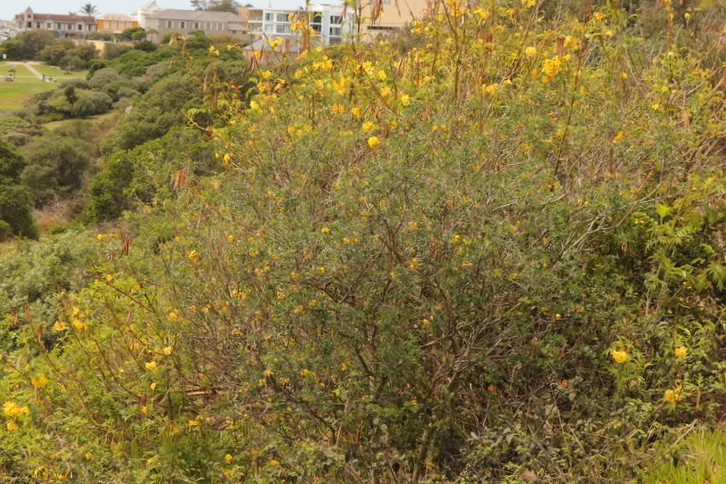
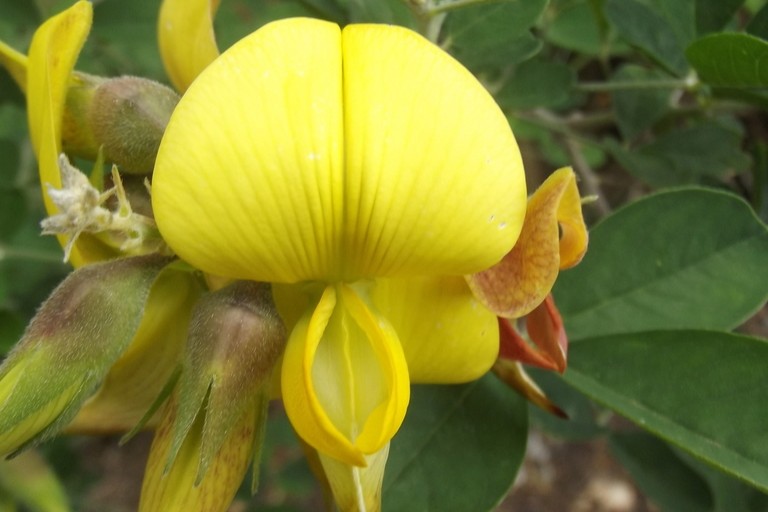
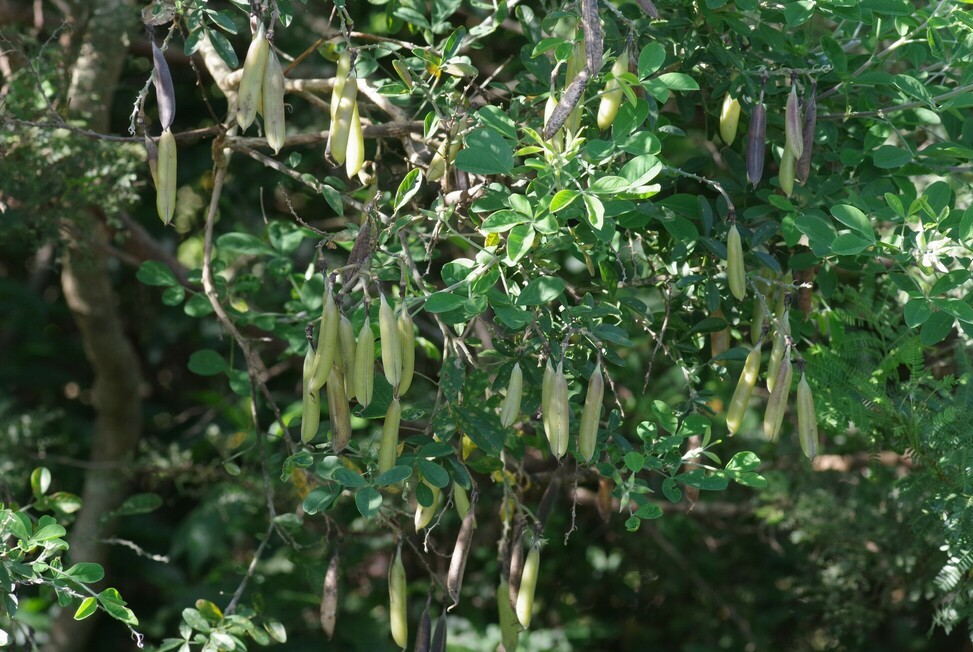
Crotalaria capensis is a much-branched, upright shrub or small tree, reaching heights of 2–5 meters. It has slender stems with drooping branches and bright green trifoliate leaves with silvery young growth. Large, striking pea-shaped flowers, bright yellow often edged with red, are borne in pendulous sprays from October to April, though blooms may appear year-round. After flowering, inflated light-brown pods develop (January – June). The pods make a distinctive rattling sound when dry, giving rise to its common name. The plant is visually prominent in the landscape due to its golden flowers and substantial growth, often forming stands on forest margins and disturbed areas.
Full sun to partial shade; does best on north or east-facing slopes.
Aspect
Sensitive to frost, requiring protection in areas with cold winters. In mild regions, it's frost tender and may lose leaves but recovers quickly.
Frost Tolerance
Poor to moderate drought. Prefers locations with regular rainfall but will survive dry periods if soil drainage is good and some supplementary water is provided.
Insects: Supports the megachilid bee species and a variety of beetles.
Butterflies:
Lampides boeticus (Pea Blue) butterflies lay their eggs on flowers. The small larvae burrow into buds or pods and feed on the seeds. They pupate near where they are feeding but generally crawl out of the pods to pupate.
Male Danaus chrysippus (African Monarch) butterflies acquire pyrrolizidine alkaloids (PAs) from dried leaves and stems from plants like Crotalaria, Senecio, and Echium. These alkaloids are stored and metabolized into dihydropyrrolizine derivatives, which are then secreted from specialized wing glands. During copulation, males transfer these compounds to females via the spermatophore, and the female subsequently uses them to coat her eggs, providing chemical protection against predators and parasitoids.
Wildlife: Provides food via flowers (nectar/pollen), leaves, and seeds to insects, birds, and small mammals. Chameleons use it for cover while hunting insects.
Soil: Nitrogen-fixing bacteria in roots improve soil fertility, benefitting nearby plant species. Often acts as a pioneer plant in reclamation and disturbed areas, facilitating ecosystem restoration by producing nutrient-rich soils.
Other Flora: Occasionally hosts insect larvae and supports epiphytes in wetter regions but is not usually parasitized by mistletoe.
Ecosystem Services: Used in restoration and rehabilitation projects, controlling erosion, and improving water cycling due to its fast growth and soil-enhancing properties.
Flowers and fruits
Main pollinators are large megachilid bees, which press down the flower’s keel to access pollen and nectar. This structural adaptation exposes pollen and nectar only to sufficiently strong pollinators, to avoid pollen and nectar being wasted on pollinators that are unlikely to deliver it to another C. capensis flower.
Various small mammals and birds may feed on seeds or use the shrub as a food source.
Birds
Provides cover and perching sites for small birds. While not a primary nesting shrub, its dense foliage and upright form offer shelter and feeding opportunities for insectivorous birds (e.g., sunbirds, bulbuls, white-eyes) attracted by insects around the flowers and pods.
By Seeds:
Seeds germinate quickly – typically within 2 weeks – when sown in autumn or spring in well-drained soil. Pre-soaking in hand-hot water is recommended, and treating with fungicide increases success.
Prick out seedlings after the first true leaves appear; protect from frost. Seedlings flower in their second year and plants grow up to 1 m per year
By Cuttings:
Young, semi-woody cuttings root well in sandy or loamy compost enriched with vermiculite or peat. Keep moist without overwatering. Success rates are reasonable but not as high as seeds.
Traditional Uses
Historical Uses: Its presence is used to indicate areas that are disturbed or are beginning ecological succession, since it is often among the first species to re-colonize damaged habitats such as degraded grasslands, fynbos, riverbanks, and forest margins.
Medicinal Uses: Limited use; some reports note use for treating minor ailments, but specific pharmacological actions need verification.
Toxicity: Seeds may contain toxic alkaloids, hazardous to livestock if consumed in large amounts.
Pharmacological action: Limited scientific data; some related Crotalaria species contain pyrrolizidine alkaloids with known biological activity.
Bioactive phytochemicals: Alkaloids typical of the genus present but specific compounds for C. capensis are not well characterized.
Livestock & Fodder: Not commonly used as fodder due to potential toxicity; occasional accidental grazing is reported but not recommended.
Cultural Significance: Seeds and pods associated with folklore and children’s play.
Ecological and horticultural significance: As a fast-growing pioneer, Crotalaria capensis plays a crucial role in succession after disturbance, rapidly stabilizing soil and restoring nutrient cycles – making it valuable in both ecological restoration and landscaping projects. Its unique “rattle pod” trait adds aesthetic and educational interest to biodiversity gardens and nature reserves.