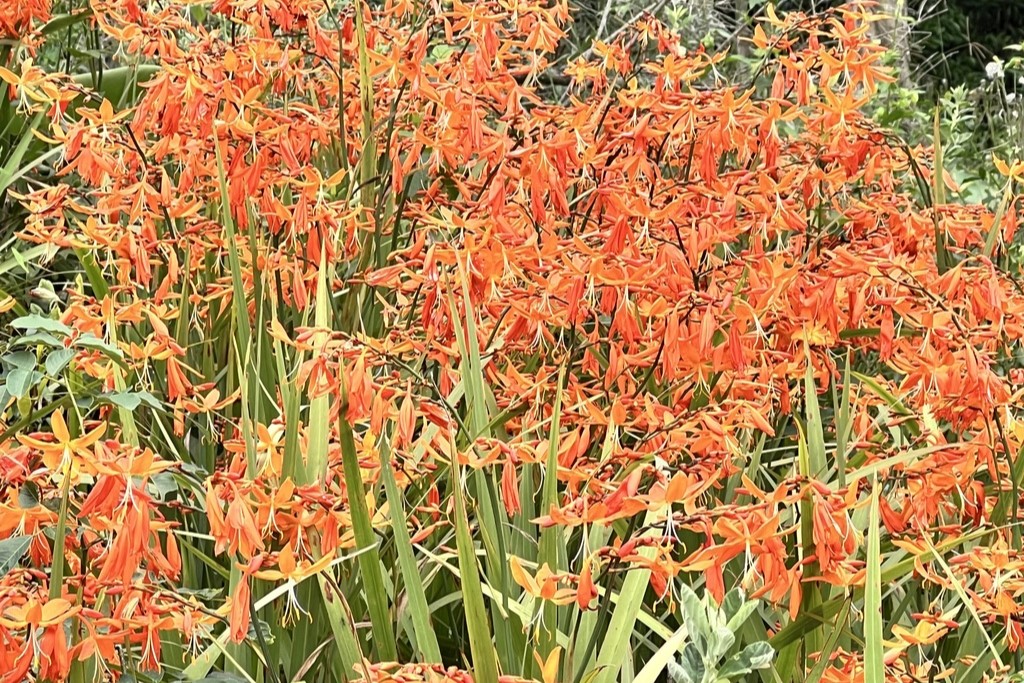
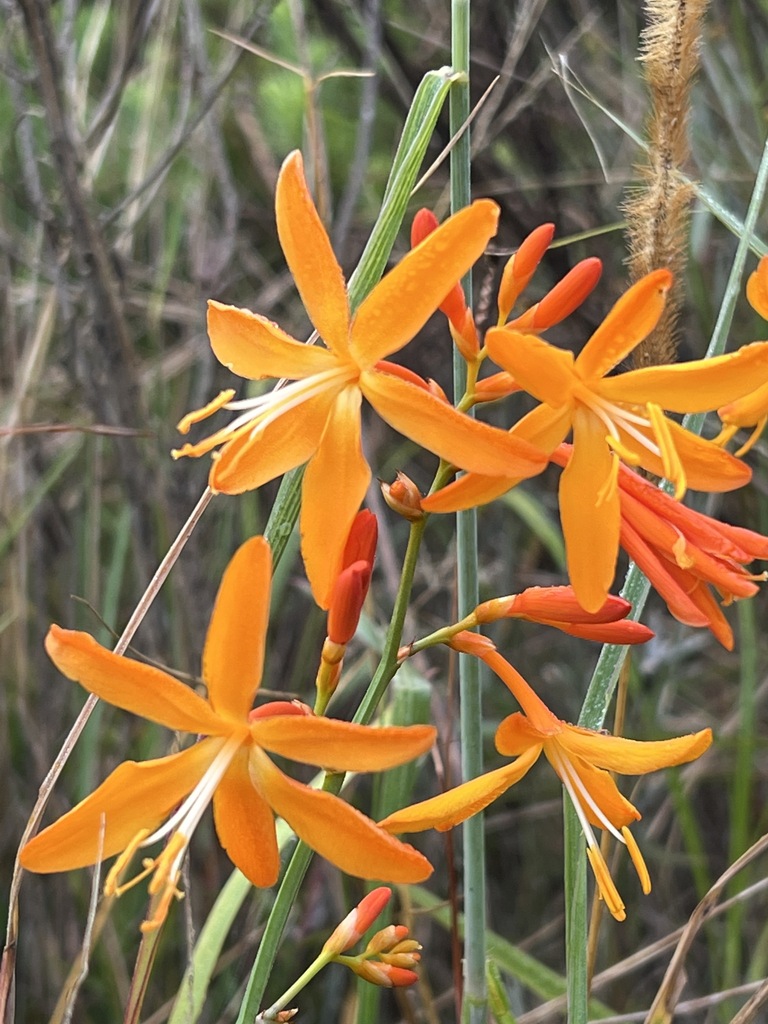
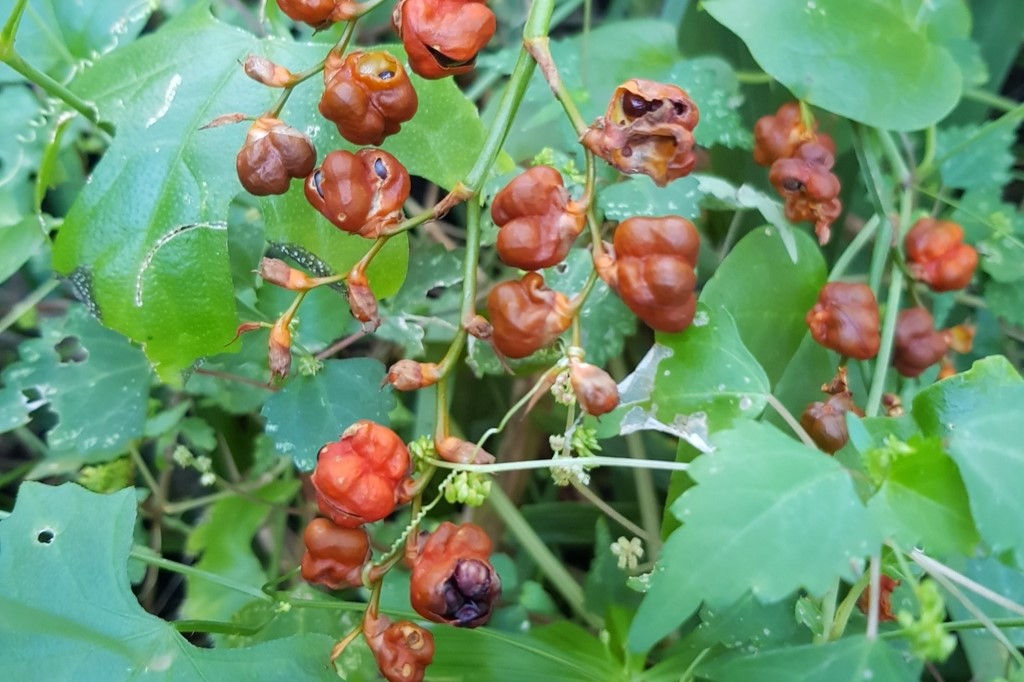
Crocosmia aurea is a robust, perennial herb growing from corms and spreading by underground stolons. The stems are strongly arched, sometimes branched, and often reach 60–120 cm tall. Several linear-lanceolate leaves, sheathed at the base, are arranged in a fan. The inflorescence spike, with 7–12 bright orange to red flowers, droops elegantly, often directed toward the ground. Flowers are up to 40 mm in diameter, with narrowly elliptic tepals, and bloom from January to June. After flowering, orange seed capsules form, containing numerous purple-black seeds. Plants are dormant in winter, resprouting in spring. Often found in large, decorative groups in shaded or damp soils, on forest margins, stream banks and wooded kloofs.
Plant Details
Height
60 - 120 cm, occasionally taller in shaded forest margins.
Thorns
Absent
Soil
Prefers moist, humus-rich soils. Grows in sandy, loamy, or clay soils where damp. Often along streams or forest margins.
Fast under moist, shaded conditions; slow in dry, exposed sites.
Growth Rate
60 - 120 cm, occasionally taller in shaded forest margins.
Size
Long-lived perennial; forms clumps by corm offsets.
Flowers attract bees, butterflies, and other nectar-seeking insects. Host for pollinators in shaded and damp habitats.
Non-nitrogen-fixing, but key wetland and forest margin stabilizer. Good restoration value for riparian and woodland edges, by stabilizes wet soils along streams, aiding erosion control and water filtration.
Commonly grows with ferns, sedges, and shade-loving forbs; offers shelter and cover in clump growth habit for small fauna.
Flowers and fruits
Bees, butterflies, and various flies visit the flowers.
Birds, especially bulbuls, eat seeds and spread seedlings. Gravity and water disperse seeds in wild habitats.
Birds
Bulbuls, thrushes, and other garden birds feed on seeds and nest in clumps. Plants also attract birds by boosting local insect populations in summer.
By Seeds:
Collect ripe orange seed capsules after flowering. Sow seeds on moist, humus-rich soil in spring/summer. Germination is rapid with warmth and moisture.
Seeds that fall to the ground germinate easily, forming large patches over time. The process can be accelerated by seeding directly into the soil.
Seeds can also be bird-planted in gardens.
By Cuttings:
Cannot be propagated by cuttings. Can be propagated from corms offsets that are divided in late winter or spring. Corms must be replant immediately.
Traditional Uses
Medicinal Uses: Used locally for treating blood disorders and gastrointestinal complaints.
Toxicity: Generally safe for humans and animals; no toxic effects recorded.
Cultural Significance: Valued as a garden ornamental, restoration species, and bird-attracting wildflower in southern and central Africa.
Ecological services: Stabilizes wet soils along streams, aiding erosion control and water filtration.