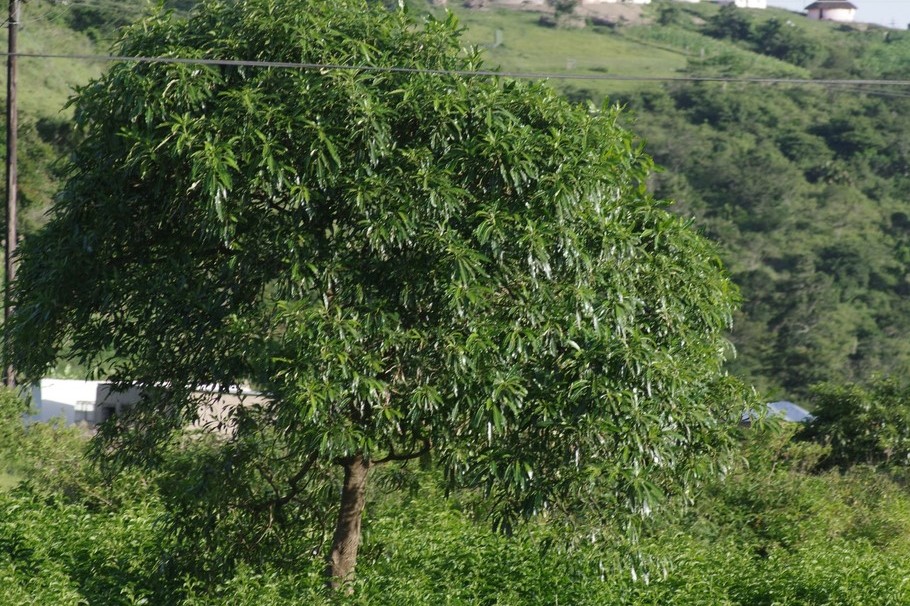
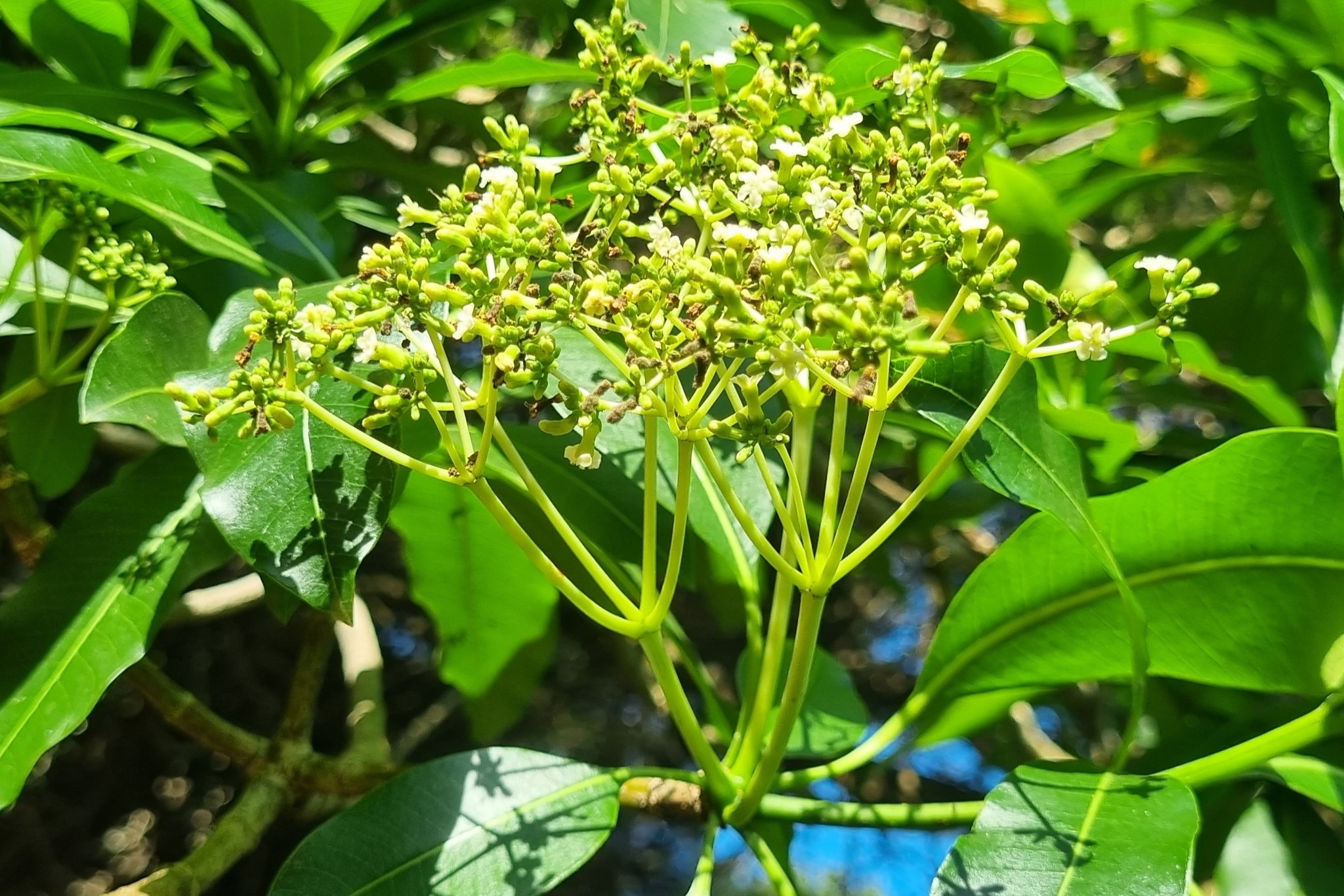
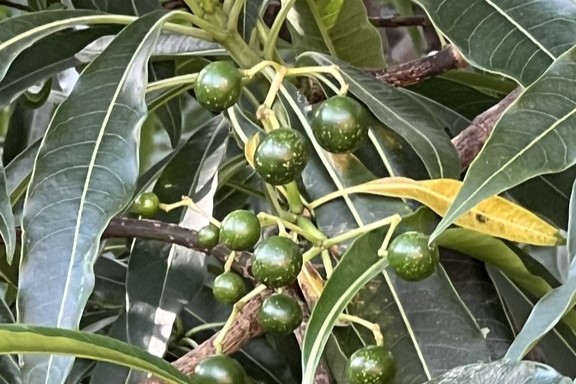
Medium to very large evergreen tree (up to 10–40 m tall) with a rounded crown and straight, bare main stem. Bark is grey to brown, rough with prominent leaf scars on young branches, becoming yellowish brown and corky with age. Leaves are large, simple, in whorls of 3–6 at branchlet tips, leathery, shiny green above, paler below, 12–28 cm long, 3–6 cm wide, smooth edged. Small, white flowers (c. 4 mm) appear in terminal sprays from May to October. Fleshy green globular fruits in clusters ripen to black October–March. The tree exudes a milky sap when injured and is found along rivers, streams, swamp forests, and forest margins, often as a water indicator. Striking, decorative shade tree for large gardens and parks, especially valued in moist or riparian landscapes. Ecologically important for riverine forest structure and as a food source for wildlife.
Plant Details
Height
10 - 30 m (up to 40m in ideal conditions); trunk diameter up to 1m
Thorns
No thorns; young stems sometimes pubescent.
Soil
Prefers sandy/loamy soils; tolerant of rich, riverine, or seasonally waterlogged ground. Needs available groundwater.
Fast; up to 1.5 m/year, especially below 500 m elevation in moist soils.
Growth Rate
10 - 30 m (up to 40m in ideal conditions); trunk diameter up to 1m
Grows with forest-edge species such as Podocarpus, Celtis africana, Syzygium cordatum, Trichilia emetica, Ficus sur and riparian sedges. Forms part of mid-upper riverine and swamp forest canopy.
Caterpillars
No specific Lepidoptera species documented, but flowers support diverse pollinators.
Associations
Descriptions
Flowers attract bees, wasps, butterflies (notably Oleander hawk moth Daphnis nerii larvae), and other insects. Fruits attract flies and seed-eating beetles.
Non-nitrogen-fixing. Aids to stabilizes riverbanks, restore riparian soil structure, provides shade and organic matter for aquatic restoration.
Dense shade can suppress grasses and forb germination below tree; hosts epiphytes and moss in moister climates.
Fruits are eaten by monkeys, bushbabies, birds (Bulbuls, Barbets, Hornbills), and occasionally browsed by game. Leaves and fruit support both arboreal and semi-aquatic foragers under forest edges.
Watercourse restoration; shade, riverbank, and wetland rehabilitation; rapid-producing timber and habitat tree.
Flowers and fruits
The abundant, small, white, sweetly scented flowers, in terminal clusters attract bees, butterflies (e.g., Daphnis nerii) and wasps.
Key late-season fruit for birds, monkeys, bushbabies. Birds and monkeys in turn disperse seeds along watercourses. Hydrophilic fruit can float and is disperse by water.
Birds
Fruits eaten by Bulbuls (e.g., Dark-capped Bulbul), Barbets, Hornbills. Habitat tree for insectivorous birds due to caterpillar/butterfly diversity. Offers shelter and nesting sites in its dense crown.
By Seeds:
Collect ripe, black fruits (Oct – Mar). Remove pulp, wash seeds. Sow in river sand/compost mix, press seeds flush with surface. Germination fast (up to 80% in 2 weeks), but seeds lose viability quickly (store <1 month). Transplant at 3-leaf stage, water well for 3 months.
By Cuttings:
Can be propagated by cuttings during growing season; use semi-hardwood cuttings, root in moist, well-drained medium; success rate moderate.
vs.
Propagates from softwood cuttings or suckers, but seed best for strong tree development.
Traditional Uses
Historical Uses: Timber for drums, furniture, shelving.
Medicinal Uses: Bark used for wound dressings and killing maggots. Latex for wounds, coughs, high blood pressure and diarrhea. Latex and alkaloids used in the treatment of mental disorders.
Toxicity: Contains alkaloids and cardiac glycosides; latex and bark are bitter, can cause poisoning in humans/livestock if consumed in excess.
Pharmacological Action: Contains antihypertensive alkaloids (incl. reserpine), anti-parasitic and anti-inflammatory also effects documented.