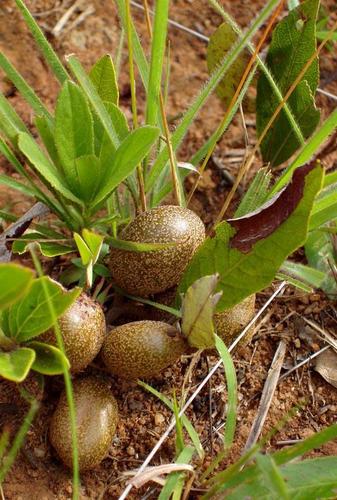
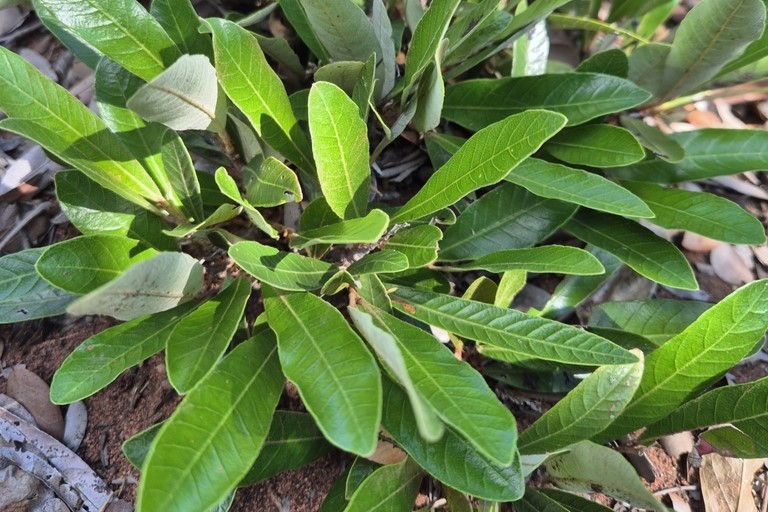
Parinari capensis is a dwarf suffrutex (woody perennial subshrub), rarely exceeding 20 cm tall, with extensive underground stems and roots. Leaves are elliptic, 1.5–7 cm long, glossy green above, distinctly whitish and lanate (woolly) below. Inflorescences are terminal and axillary near ground level, with small, white, cream, or yellow flowers and a hairy sand-colored calyx. Fruits are plum-like, yellow-orange with grey speckles when ripe, and edible. This species flowers in spring (September–October), forms dense mats, and is adapted as a geoxyle for fire-prone grasslands, with much of its mass hidden underground.
Plant Details
Height
10–30 cm above ground, rhizomes can extend much further horizontally.
Thorns
Absent
Soil
Deep sandy soils; tolerates low-nutrient and seasonally waterlogged ground.
Moderate; rapid vegetative spread after fire or disturbance.
Growth Rate
10–30 cm above ground, rhizomes can extend much further horizontally.
Size
Perennial, with underground stems persisting for decades (50 - 70 years).
Pairs with other geoxyles, sandy soil forbs, and low-lying grassland shrubs. Effective with Dichapetalum cymosum and bushveld annuals for restoration and sandy meadow gardens.
Caterpillars
Supports some butterfly species.
Associations
Descriptions
Not nitrogen-fixing. Stabilizes sandy soils and acts as a pioneer following fire with deep underground stems (geoxyle).
Frequently found with grassland geoxyles and sandy soil specialists (e.g., Dichapetalum cymosum).
Pioneer species in grassland restoration, excellent for erosion control, rapid recovery after fire (immortal underground forests). Forms habitat mats for insects, spiders, and ground-nesting fauna.
Flowers and fruits
The small flowers are nectar-rich, attracting small bees and flies in native grassland.
Persistent fruit supports dry-season wildlife and local foragers, such as birds, monkeys and small mammals. Fruits edible for humans.
Birds
Provides food and shelter for frugivorous and insectivorous birds.
No records of specific bird species, but fruit-eating bushveld birds likely feed on ripe sand apples. The groundcover habit provides foraging and shelter.
By Seeds:
Collect fresh seeds from ripe fruits, clean and scarify or soak before sowing to enhance germination. Sow directly into sand. Germination is best in early summer with water.
By Cuttings:
Difficult; propagation mainly by seed.
Traditional Uses
Historical Uses: Fruit consumed as seasonal bush food; used in traditional healing and rituals for centuries in multiple African ethnic groups.
Medicinal Uses: Employed to treat digestive and respiratory issues. Anti-malaria uses reported across grassland cultures. Fruit, bark, and roots used in diverse remedies for the treatment of snake bite, infections, diabetes, anemia, hypertension, liver disease
Toxicity: No major toxicity recorded—fruit edible, but plant may share some secondary compounds with poisonous relatives.
Pharmacological Action: Contains triterpenoids, kaurane diterpenes, but not alkaloids. Several studies indicate anti-malarial, anti-inflammatory, and anti-diabetic activities.
Bioactive phytochemicals: Kaurane diterpenes, triterpenoids, flavonoids, though not all compounds have been fully characterized.
Livestock & Fodder: Not a main fodder species; possible wild browsing, but not a curated forage crop.
Cultural Significance: Considered a “geoxyle” pioneer in fire-prone grasslands—forms “immortal underground forests” of major ecological and cultural significance in Southern Africa.