Wildeperske
uMunwe
umKokoko
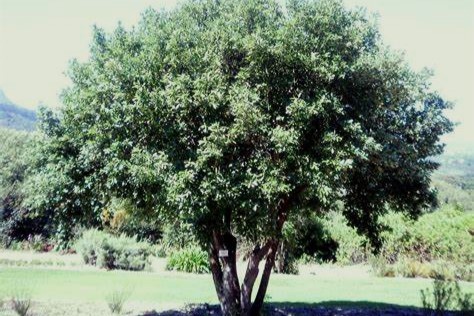
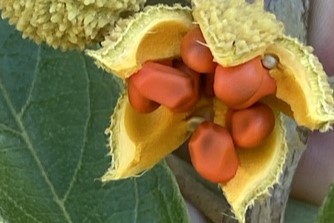
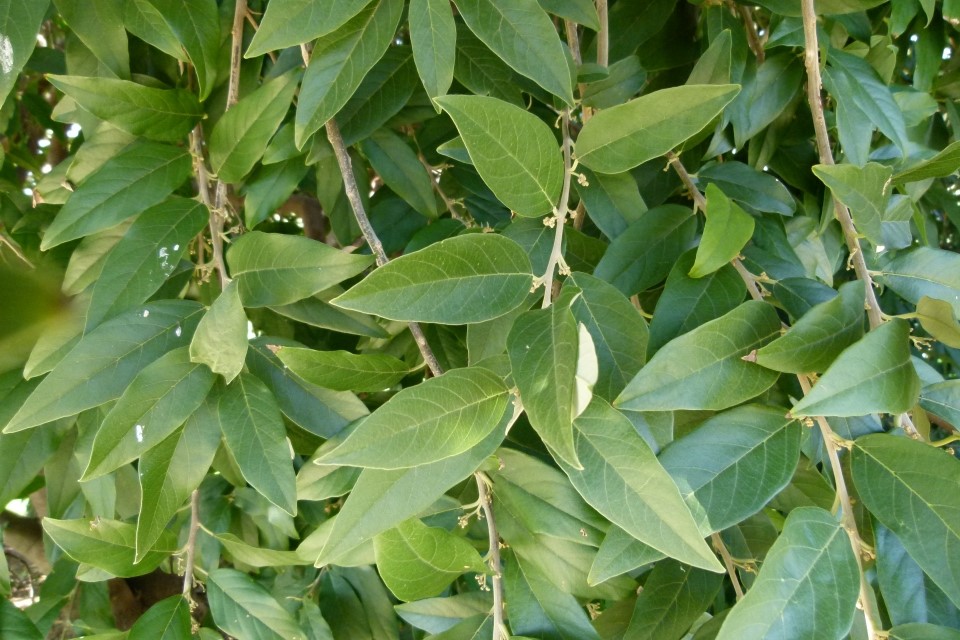
Kiggelaria africana is a well-shaped, robust, evergreen tree that grows from 6–20 m high with multiple low branches. The crown is dense and round. Bark is smooth, pale grey, becoming rough with age. Leaves are simple, alternate, elliptic to ovoid, glossy grey-green above, paler and lightly hairy below, sometimes toothed, 4–12 cm long. Flowers are tiny, bell-shaped, yellow-green, borne August–January. Male and female flowers are on separate trees (dioecious). The fruit is a round, knobbly greenish-yellow capsule. It ripens late summer–winter, splitting to expose shiny black seeds coated in bright orange, oily aril. Its root system is designed for non-aggressive spread and deep anchoring. It is adaptable to gardens, forests, bushveld, streambanks, rocky hillsides, and montane grassland.
Insects: Caterpillars often defoliate the trees, which triggers rapid leaf regrowth.
Abundant clusters of several different capterpillars, such as Acraea horta, thrive on Kiggelaria africana because their toxicity protects them from most predators, allowing females to lay large groups of eggs and support dense populations, even to the point of defoliation. (In contrast, caterpillar species that feed on non-toxic plants typically lay single eggs or small batches and rarely reach high densities, mainly due to much higher predation pressure.)
Wildlife: K. africana offers only limited browsing value for mammals, since its toxic, cyanogenic leaves are not favored by livestock or wild herbivores, though some animals may occasionally sample the leaves, seeds, or pods without serious negative effects if intake is limited.
Provides shade and cover for garden wildlife, including reptiles and small mammals.
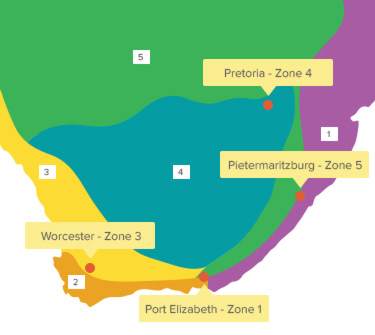
Ecosystem Services: Restoration of forest margins and riverbanks, through providing erosion control, shade, and windbreaks. Exceptional for rapid wildlife support and pollinator-hosting dynamics. Good for providing screening and shade in the garden. Can be used in both summer and winter rainfall ecological zones.
Pollinators: Insects, especially bees and flies, pollinate flowers. Cross-pollination is required between male and female trees.
Wildlife: Several mammals are known to feed on the fruits and seeds of Kiggelaria africana.
Baboons and monkeys consume the fruit, especially when they encounter trees in forests, wooded rivers, or gardens.
Bushpigs are reported to feed on the fruits, particularly the fleshy seed coatings and the seeds themselves.
Antelope species such as bushbuck and possibly duikers may nibble on fruits and seeds when available.
Rodents may occasionally sample the oily seed coating, especially if fallen fruit is accessible
Fruit-Eating Behavior
A wide variety of fruit eating birds such as Crowned Hornbill, Olive Woodpecker, Cape Thrush, Cape Robin-chat, Cape White-eye, Southern Boubou, Mousebirds (such as Speckled and Blue-naped), Bulbuls, Starlings, Robins, and Starlings, are attracted to the tree during fruiting season to eat the oily red seed coatings and sometimes the black seeds themselves, helping disperse its seeds across the landscape.
Mousebirds, in particular, are noted for eating the black seeds, while many others target the fleshy, brightly coloured seed coats.

Birds eating the abundant caterpillars on the trees
Several caterpillars, such as Acraea horta, that feed on K. africana are toxic because they sequester cyanogenic compounds, notably gynocardin, from the plant. Enzymes in the caterpillar’s guts hydrolyse the cyanogenic glycosides, forming hydrogen cyanide (HCN), which disrupts cytochrome oxidase in mitochondria, making the caterpillars highly distasteful and often lethal to most insectivores and birds.
It’s because the caterpillars are toxic that the eggs can be laid in large clusters, and an abundance of caterpillars can defoliate the tree.
Selectivity of Bird Predators
Cuckoos can dramatically reduce the amount of cyanide ingested. Before cuckoos (e.g., Diederik, Red-chested, Klaas’s, and Black Cuckoo) swallow the toxic caterpillars, they “prepare” them by removing the gut contents, which are the main reservoirs of freshly ingested cyanogenic glycosides. They bash or squeeze the caterpillar and sometimes slice it open to expel the gut contents, which contain the freshly eaten toxins from the host plant.
Cuckoos also have a thick mucous membrane lining their gizzards that helps trap and later regurgitate spiny hairs and some toxic residues as pellets, further enhancing their ability to process toxic prey.
This preparation behaviour is observed across cuckoo species worldwide, especially those consuming hairy or brightly coloured toxic caterpillars.
Seeds must be collected from mature, split capsules with arils. Remove aril before sowing in moist, compost-rich soil in spring. Keep seedbeds moist. Germination occurs rapidly if seed is fresh and seedlings will grow quickly. Set seedlings out at 30 cm tall to prevent them from becoming pot bound.
Young tip cuttings can be taken in spring or autumn and rooted in a sandy/loamy medium. Keep humid until rooted.
Historical Uses: Timber for beams, floorboards, and furniture; spokes of wagon wheels; believed to attract or protect against lightning; used in kraal protective medicine.
Medicinal Uses: Bark/wood decoctions used for respiratory complaints, spiritual protection, topical wound healing in South Sotho tradition.
Toxicity: No major toxicity documented; arils edible to birds, not toxic to animals/humans.
Pharmacological Action: Contains cyanogenic glycosides (family trait); care required in medicinal use.
Bioactive phytochemicals: Cyanogenic glycosides indicated, more research needed.
Livestock & Fodder: Not significant for browsing/grazing; leaves occasionally browsed by livestock. Fruits eaten by birds, monkeys, and baboons.
Cultural Significance: Used for shade, garden screening, protection charms, and admired for its role in bird and butterfly gardens; considered both a lightning attractor and protector by traditional belief..